Bathroom remodel cost in Australia: A 2026 budget guide
A bathroom is one of the most expensive rooms per square metre to renovate, because so many trades and waterproofed systems meet in a small, tightly regulated space. That is also why the bathroom remodel cost quoted to two homeowners can differ by tens of thousands of dollars for a room the same size. The difference is rarely the tiles alone: It is the layout, the plumbing, the extent of tiling, the fixtures tier, and how many decisions change after the work has started.
This guide sets out realistic 2026 Australian price ranges, a full component breakdown, the factors that move the number most, and where to spend versus save. It also covers the decision that quietly protects a bathroom budget more than any product choice: Confirming your layout and finishes before you commit, so a change of mind does not become a change order priced at the trade’s margin.
Learn more: how house renovation 3D design helps Melbourne homeowners plan a renovation
What does a bathroom remodel cost in Australia in 2026?
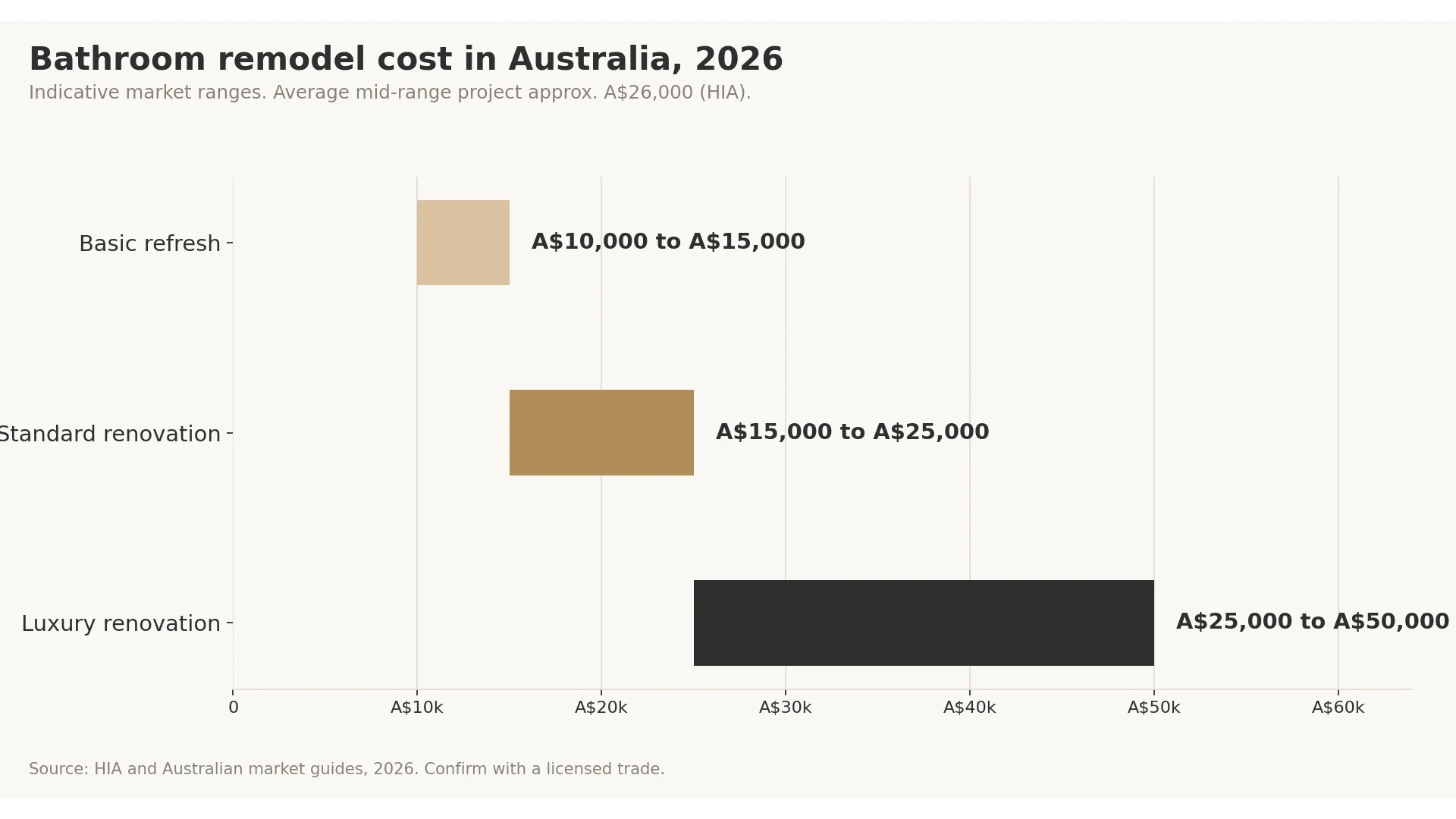
As an indicative guide, a full bathroom remodel in Australia in 2026 generally falls between about A$10,000 and A$35,000+, with the Housing Industry Association putting the average mid-range project at roughly A$26,000. On a per-square-metre basis, most renovations land around A$2,300 to A$4,600 per m². Treat every figure as indicative until a licensed trade quotes your specific room, because condition, access and selections change the result.
| Renovation level | Typical scope | Indicative cost (2026) |
|---|---|---|
| Basic refresh | Keep the existing layout and plumbing positions; new fittings, some retiling | A$10,000 to A$15,000 |
| Standard renovation | Strip back, re-waterproof, fully retile, replace all fittings | A$15,000 to A$25,000 |
| Luxury renovation | Layout changes, relocated plumbing, premium fixtures and features | A$25,000 to A$50,000+ |
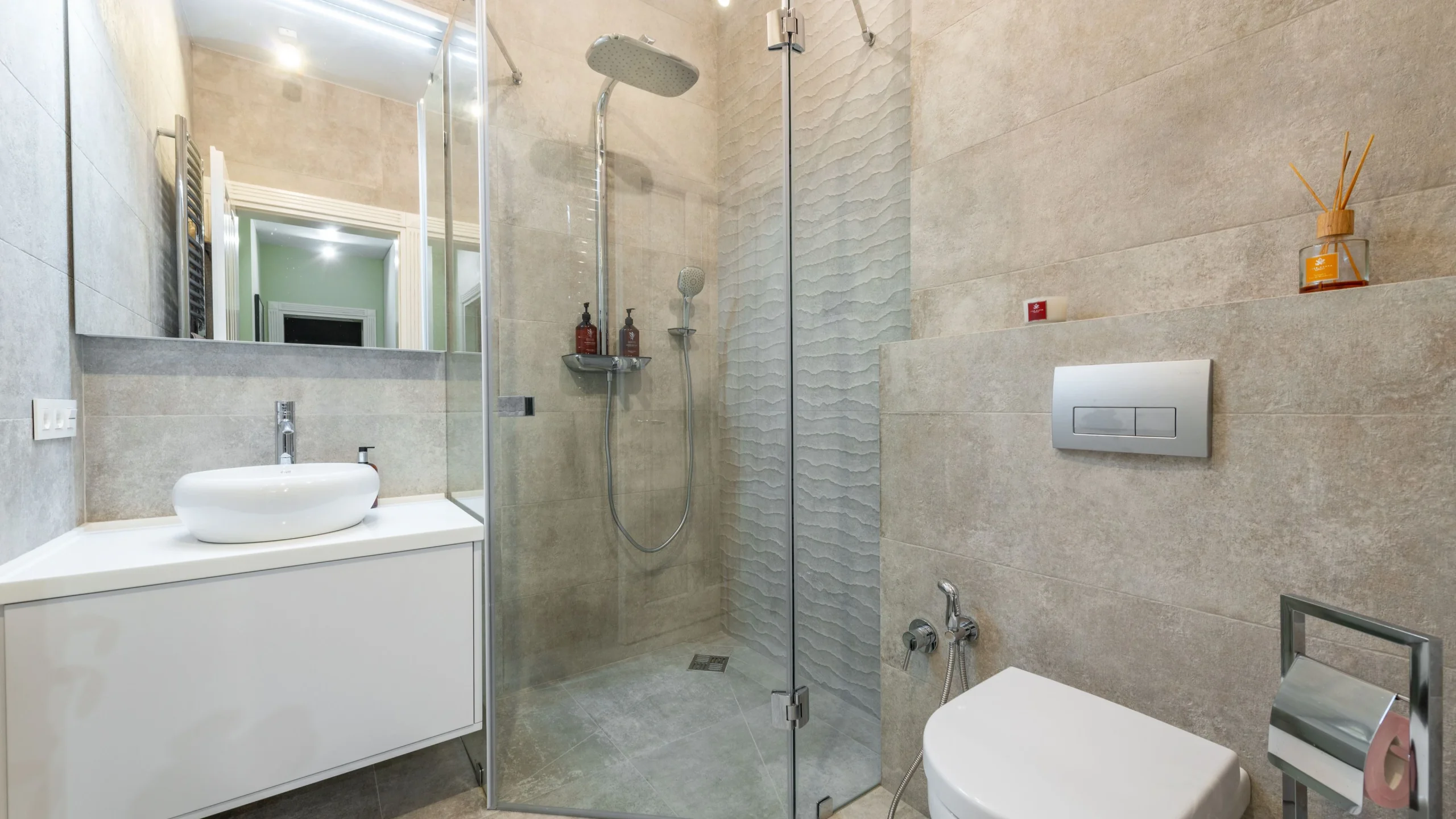
Key insight: The single biggest lever is whether the toilet, shower and basin stay where they are. Keeping the plumbing in place can hold a project in the basic-to-standard range; relocating it moves the same room into luxury-renovation territory.
Bathroom remodel cost breakdown by component
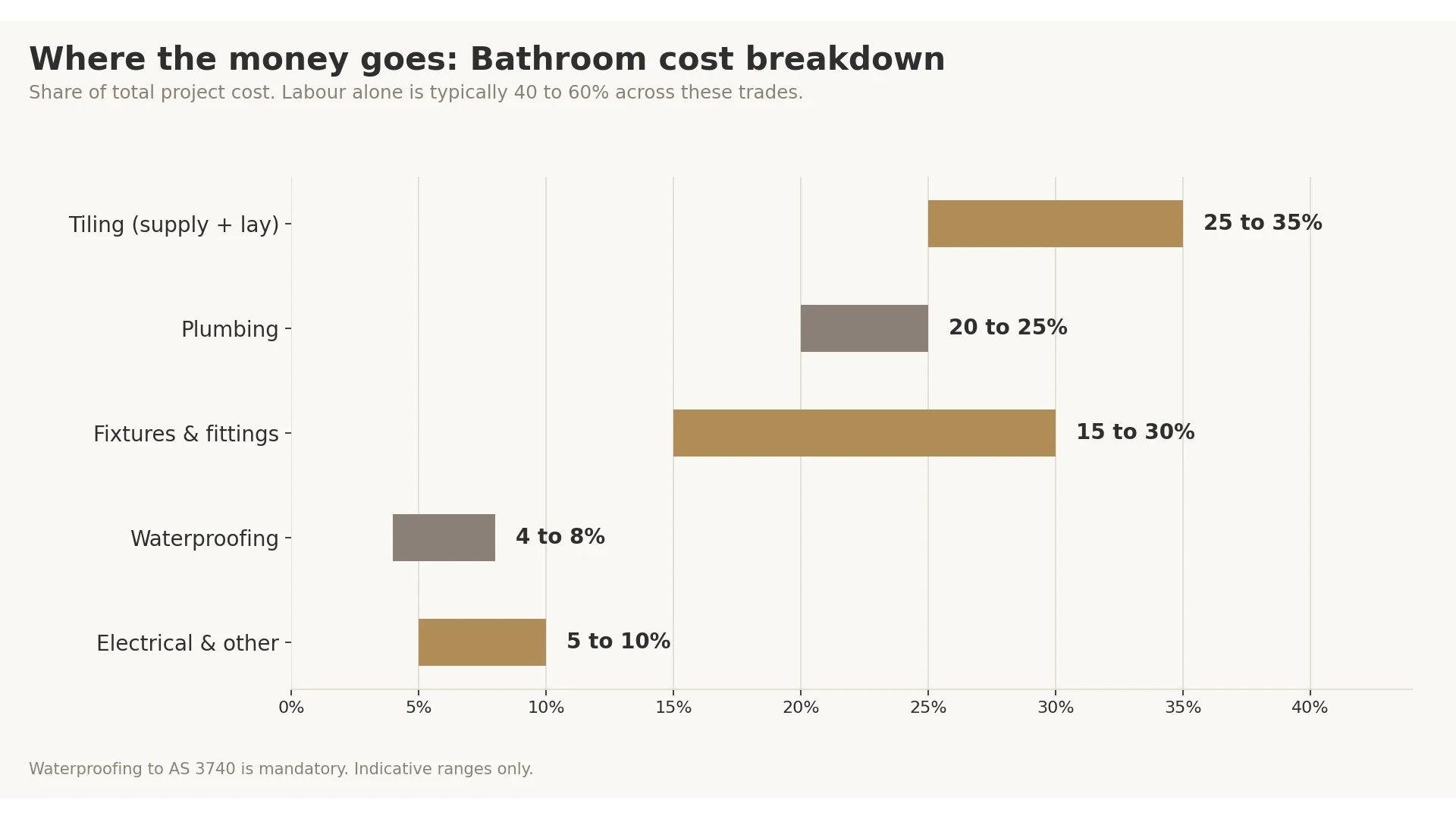
Labour typically accounts for 40 to 60% of a bathroom renovation, spread across the plumber, tiler, electrician, waterproofer and, where walls move, a carpenter or builder. The table below shows how a typical budget divides.
| Component | Share of budget | Indicative cost | What drives it |
|---|---|---|---|
| Plumbing | 20 to 25% | A$3,000 to A$10,000 | Whether fixtures stay in place or are relocated; trades charge roughly A$80 to A$120 per hour |
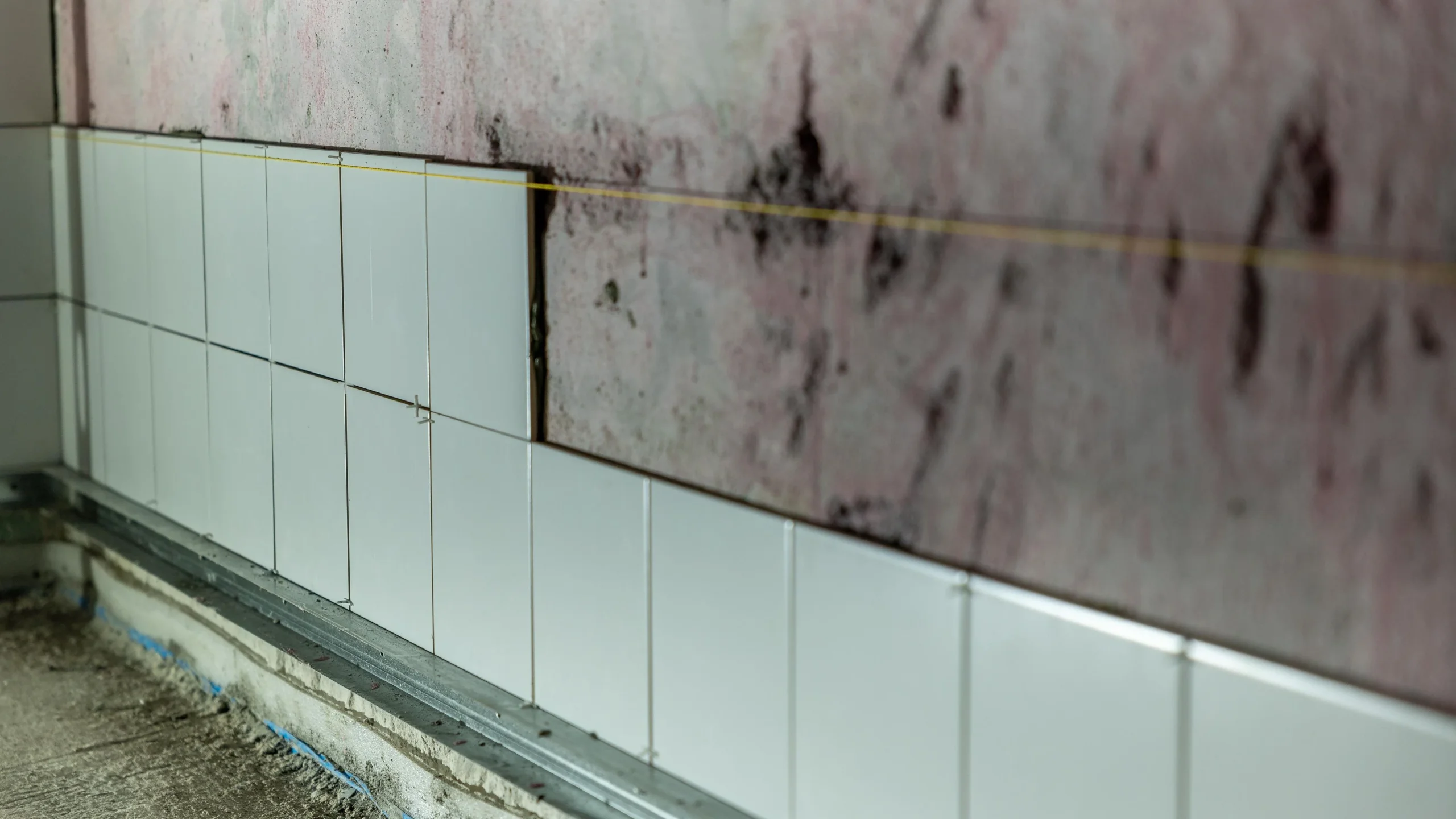
| Tiling (supply and lay) | 25 to 35% | A$3,000 to A$12,000 | Extent of tiling; supply is A$35 to A$120 per m², laying A$50 to A$70 per m², driven more by labour than tile price |
| Waterproofing | Smaller line item | A$800 to A$2,500 | Bathroom size and compliance with AS 3740; a legal requirement, not an optional saving |
| Fixtures and fittings | Varies widely | A$2,000 to A$15,000+ | Vanity, toilet, basin, shower screen, tapware, towel rails and mirror, and the finish tier chosen |
| Electrical | Smaller line item | Varies | Lighting, exhaust, heated towel rails or under-tile heating, GPO changes |
The biggest cost drivers
- Layout change and plumbing relocation: Moving the toilet, shower or basin means new drainage and rough-in, which cascades into slab or wall work and is the most reliable way to increase cost.
- How much of the room is tiled: Floor-to-ceiling tiling is labour-intensive; wall tiling alone can take two to three days, and labour, not the tile, sets the price.
- Fixtures tier: The jump from builder-grade to premium tapware, a stone or sintered-stone vanity top, a frameless screen and a smart toilet can add many thousands on its own.
- Waterproofing and compliance: Waterproofing to AS 3740 is mandatory and best not compromised; failures here are the most expensive to fix later.
- Hidden and structural conditions: Rot, old plumbing, asbestos or an uneven substrate discovered after demolition can add unplanned cost, which is why a contingency matters.
- Location: Sydney homeowners typically pay around 15 to 25% above the national average, reflecting higher labour rates and compliance costs; Melbourne, Brisbane, Perth and Adelaide vary on the same basis.
Where to spend and where to save
Prioritise spend on:
- Waterproofing and plumbing done correctly: The systems you cannot see are the ones that cost the most to redo.
- Tapware and fixtures you touch daily: Quality tapware and a well-built vanity age better than the cheapest option.
- Tiling labour: A good tiler protects both the waterproofing and the finished look.
Value-engineer with less risk on:
- Tile selection: A mid-priced tile laid well often reads better than an expensive tile laid poorly; the labour is the constant.
- Feature versus field: Use a premium tile or stone as a feature and a simpler tile elsewhere.
- Keeping the layout: The cheapest premium bathroom is one where the plumbing did not move.
The decision that protects a bathroom budget most
The most expensive line in many bathroom projects is not on the original quote at all: It is the variation. A change of tile, a re-selected vanity, a tapware finish that looks different once installed, or a layout tweak after demolition are all priced at the trade’s margin, at the point when you have the least leverage. Decisions confirmed before work starts cost nothing to change; the same decisions made mid-project are the ones that blow a budget.
This is where reviewing your bathroom in context, before you commit, pays for itself. Seeing the finishes together, under realistic lighting and at full scale, lets you resolve the choices that otherwise become variations. DX Living’s DX Interiors and immersive visualisation help homeowners and designers compare bathroom materials and layouts before procurement, so the brief that goes to the builder is stable. DX Living is a visualisation partner, not a builder or renovator, and any figures here are indicative market ranges, not a quote.
What separates a standard bathroom from a designer bathroom
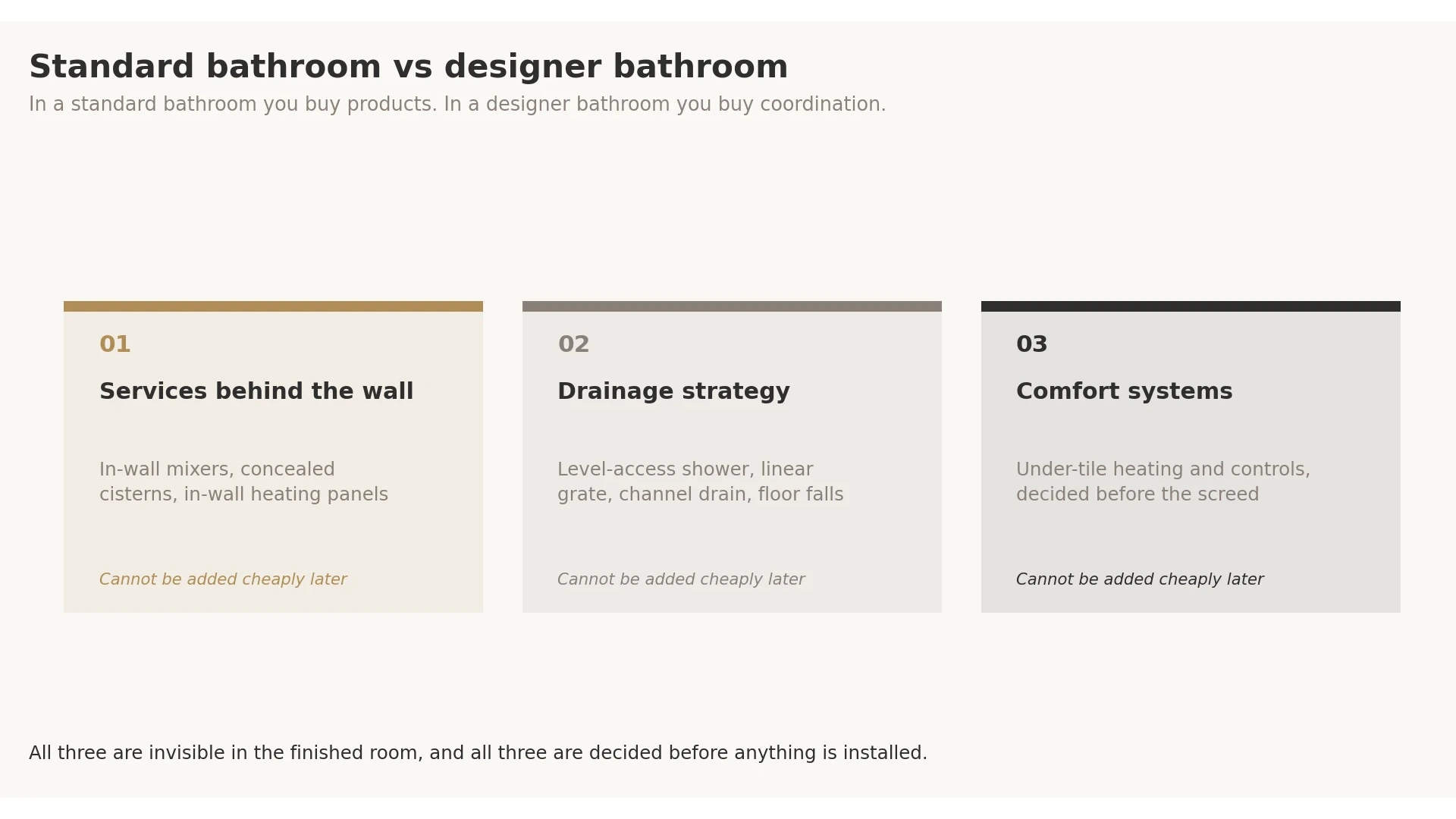
The ranges above describe the mainstream market. Once a bathroom moves into designer or luxury territory, the cost is driven less by the visible fittings and more by three layers most homeowners never budget for.
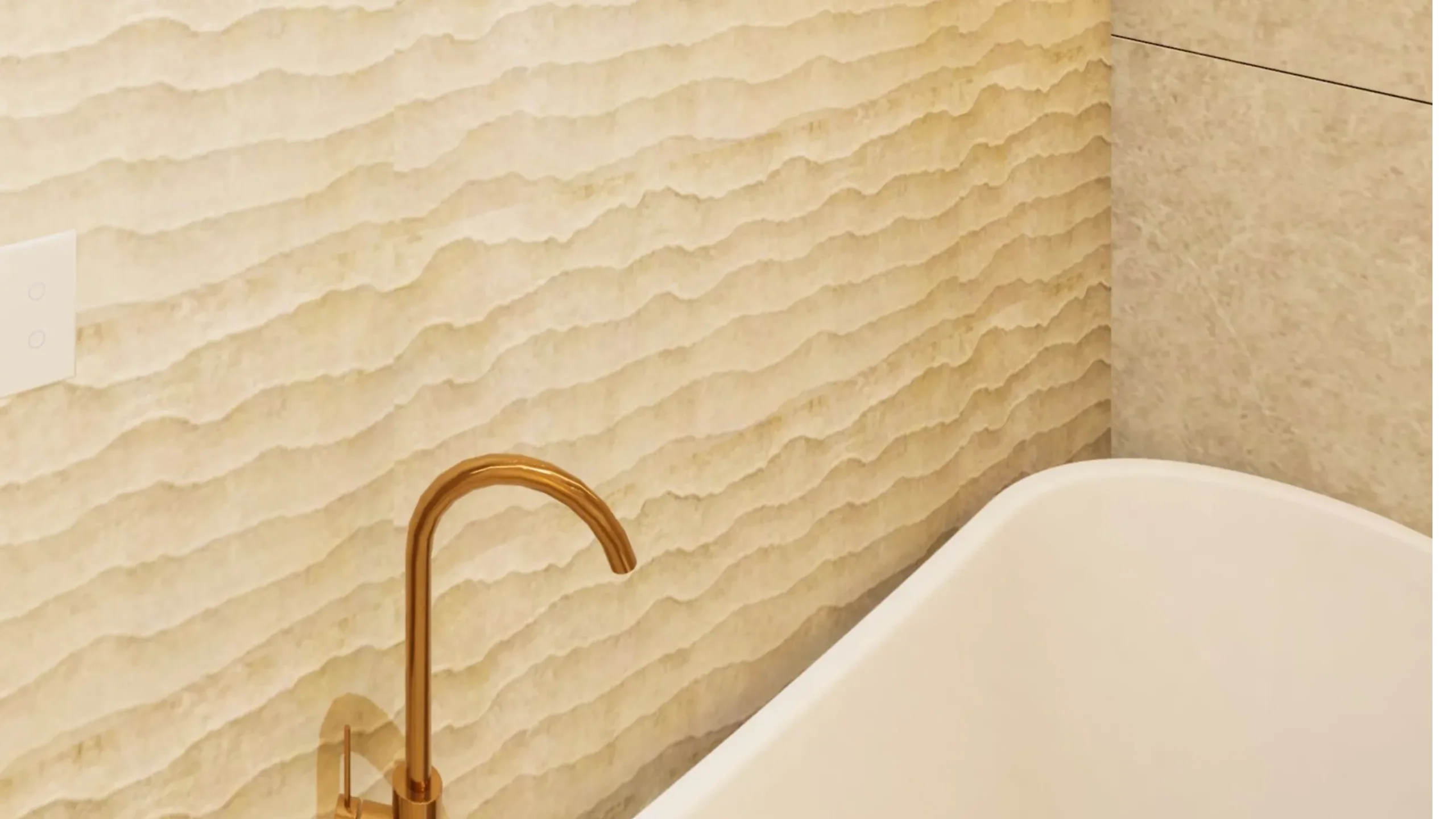
- The services layer behind the wall: In-wall mixers, concealed cisterns, in-wall heating panels and integrated drainage all require the wall or floor build-up to be designed around them. The tapware you see is a fraction of the cost; the rough-in, framing and coordination behind it is the rest.
- The wet-room and drainage strategy: Level-access showers, linear grates and channel drains change the floor falls, the waterproofing detail and the tile setout. This is a design decision made long before tiling, and it cannot be added cheaply later.
- Comfort systems: Under-tile heating, in-wall panel heating and controllers are decided before the screed and the floor finish go down. Retrofitting them means lifting the floor you just paid for.
Key insight: In a standard bathroom you are largely buying products. In a designer bathroom you are buying coordination. That is why two rooms with the same footprint can differ by A$20,000 or more, and why the specification must be settled before trades mobilise.
A worked example: The Project 251 bathroom specification
To make this concrete, it helps to look at a real luxury specification. Project 251, an in-progress DX Living visualisation project at 251 Station St., Edithvale VIC, includes bathrooms and ensuites specified to a designer level. The selections shown in approved visuals are indicative of the design direction rather than final selections, and no project costs, quotes or supplier details are published. What the specification usefully demonstrates is where a luxury bathroom budget actually goes.
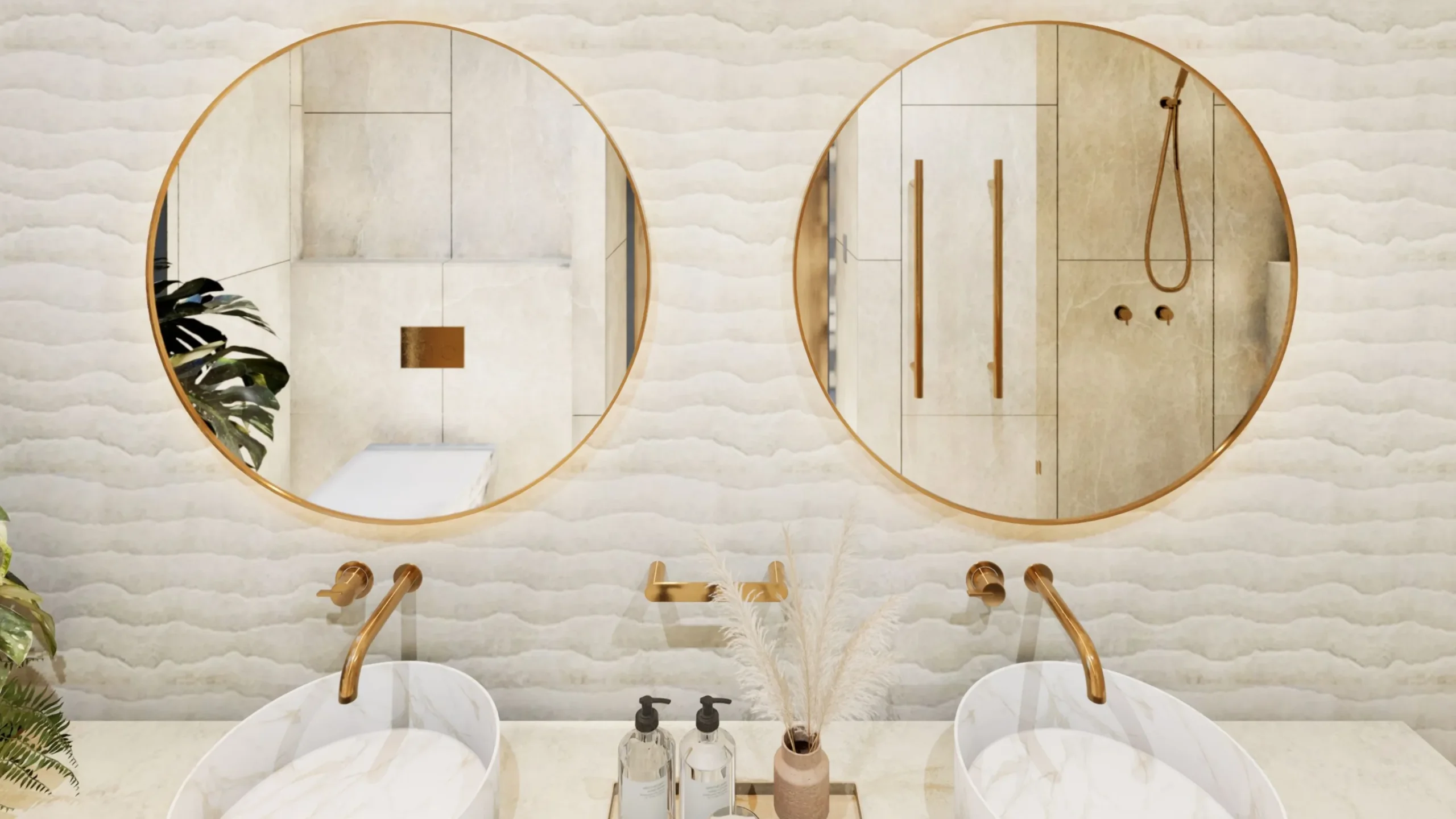
The palette runs on a single idea: A warm brushed brass and gold metal language, set against sintered stone, concrete and tile, with the comfort and drainage systems hidden inside the build-up. Read as a budget, it breaks into four groups.
| Element group | Project 251 direction | Cost behaviour versus standard |
|---|---|---|
| Tapware and metals | Brushed brass and gold, including an in-wall mixer and matching accessories | Finish premium plus in-wall rough-in and coordination |
| Vanity and basin | Sintered stone vanity top with a concrete basin | Surface and bespoke basin premium |
| Sanitaryware | Smart toilet suite | Product premium plus a power point at the pan |
| Comfort and drainage | In-wall panel heating with a controller, under-tile heating, linear tile-insert grate and channel drain | Design-stage systems that cannot be retrofitted cheaply |
The materials, and the story behind each
A specification like this is not a shopping list. Each item is chosen for a reason, and each reason has a cost consequence. This is the level of detail worth resolving before you commit.
Brushed brass tapware, and the discipline of one finish
Project 251’s tapware direction is ABI, an Australian brand based on the Gold Coast that sells direct and finishes its ranges in PVD. That last detail matters more than it sounds. PVD is a vacuum-deposited coating that is significantly harder and more colour-stable than traditional electroplating, which is why brushed brass and gold finishes can now be used in a wet area without the fear that they will patina unevenly within a few years. The specification carries the same finish across a hob mixer, a thin-spout basin outlet, the shower set and the accessories, so the room reads as one composed idea rather than a collection of parts.
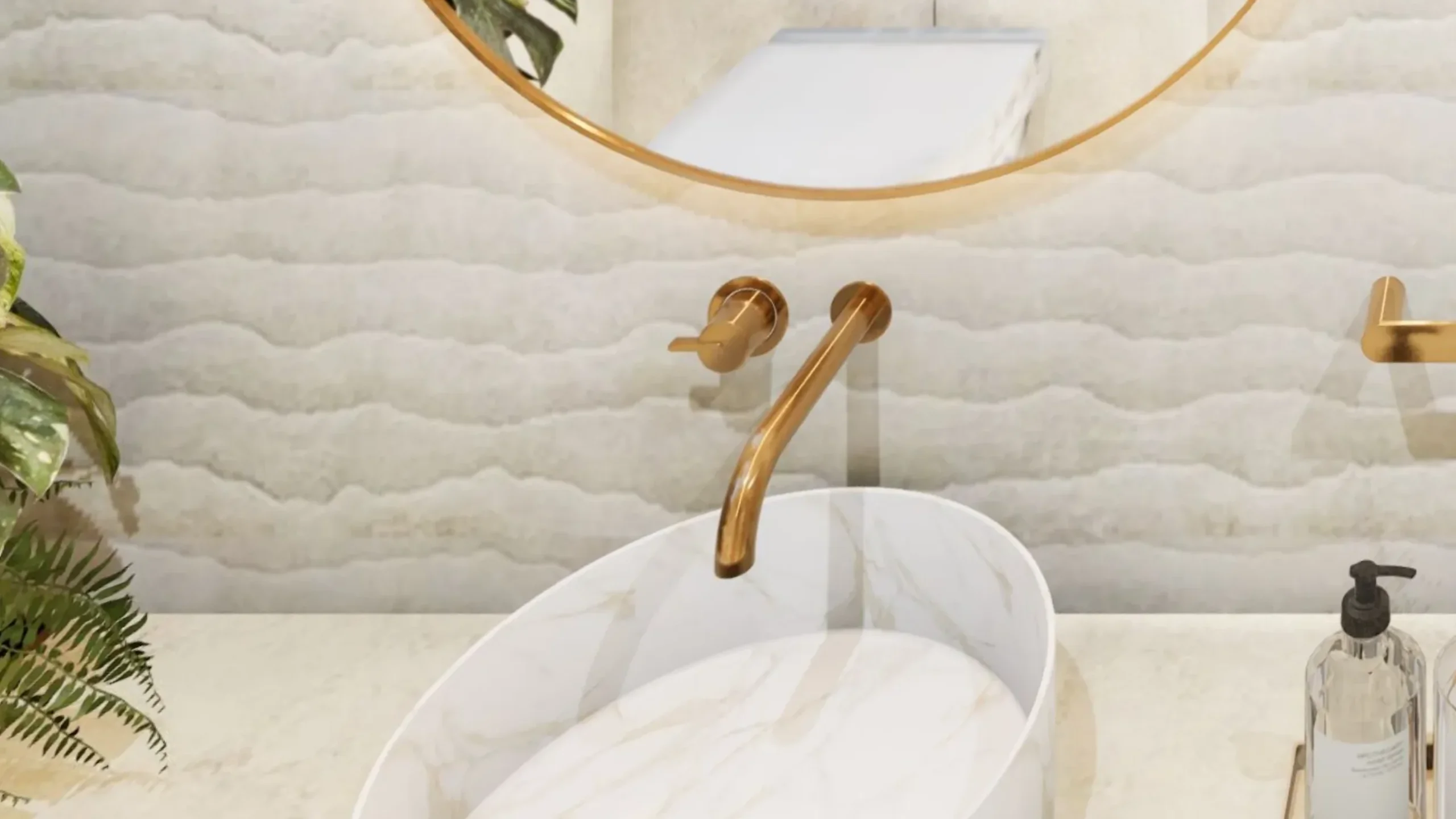
The cost story: A PVD brushed-brass or gold finish typically carries a meaningful premium over chrome across every item, and because the language is repeated throughout the room, that premium multiplies. The upside is that a single, consistent finish is one of the cheapest ways to make a bathroom look designed rather than assembled.
The in-wall mixer, or paying for what you cannot see
The specification includes an in-wall reverse mixer. Visually, this is the quietest element in the room: A single handle on a clean tiled wall, with no visible body. That cleanliness is the whole point, and it is also the expense. The valve body sits inside the wall, which means the framing, the rough-in position and the tile setout must all be coordinated before the wall closes.
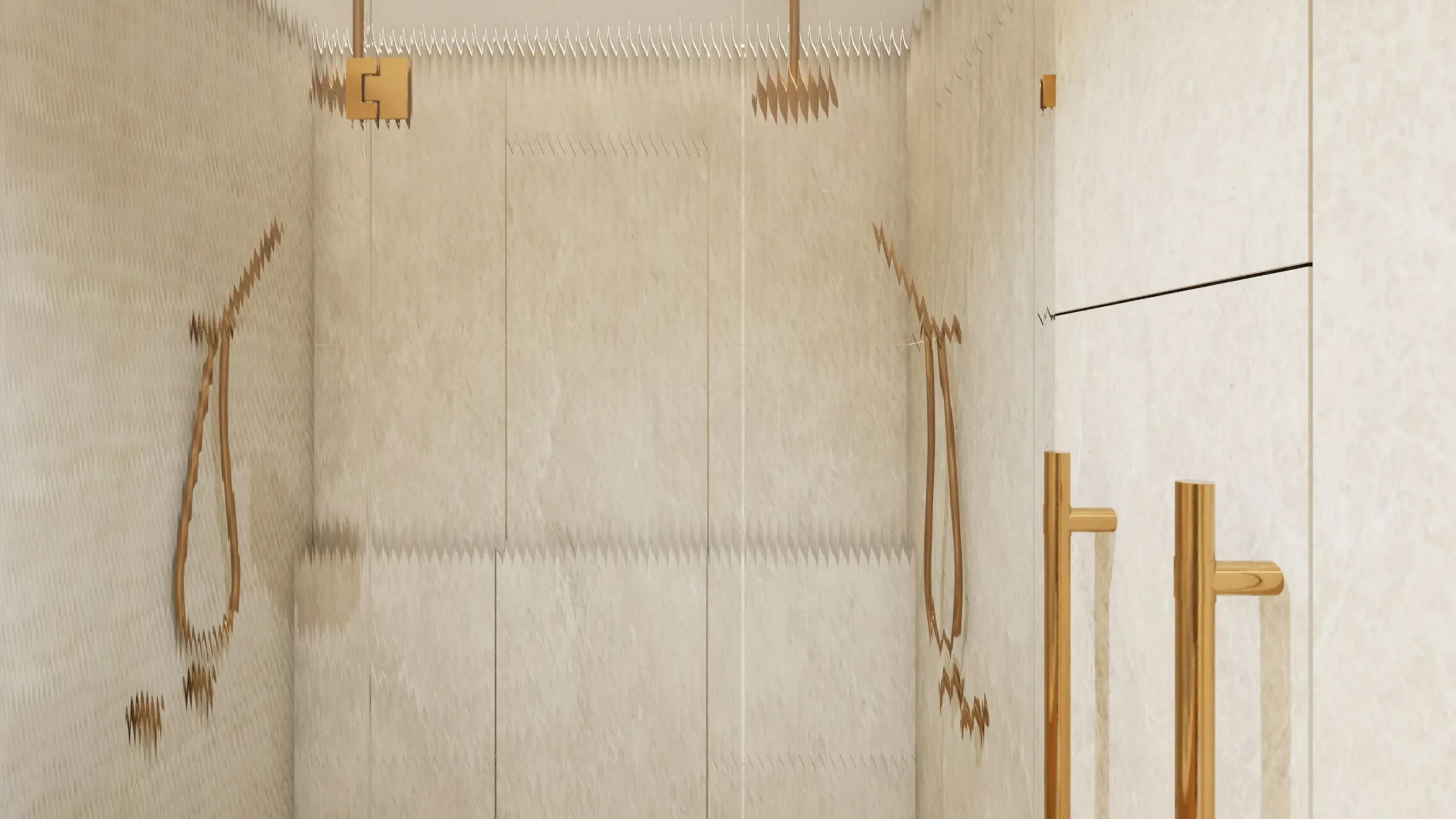
The cost story: The tapware price is only part of it. You are also paying for plumbing rough-in and precise coordination, and the decision is effectively irreversible once the wall is lined. Get it wrong and the fix is demolition, not a swap.
A concrete basin against a sintered stone top
The vanity pairs a sintered stone top with a concrete basin. It is a deliberate contrast: Sintered stone is a highly engineered surface, manufactured under heat and pressure to be dense, non-porous and resistant to heat, scratching and staining, while a concrete basin is a cast, handmade object with slight variation between pieces. One is precision, the other is texture, and the tension between them is what stops a luxury bathroom feeling sterile.
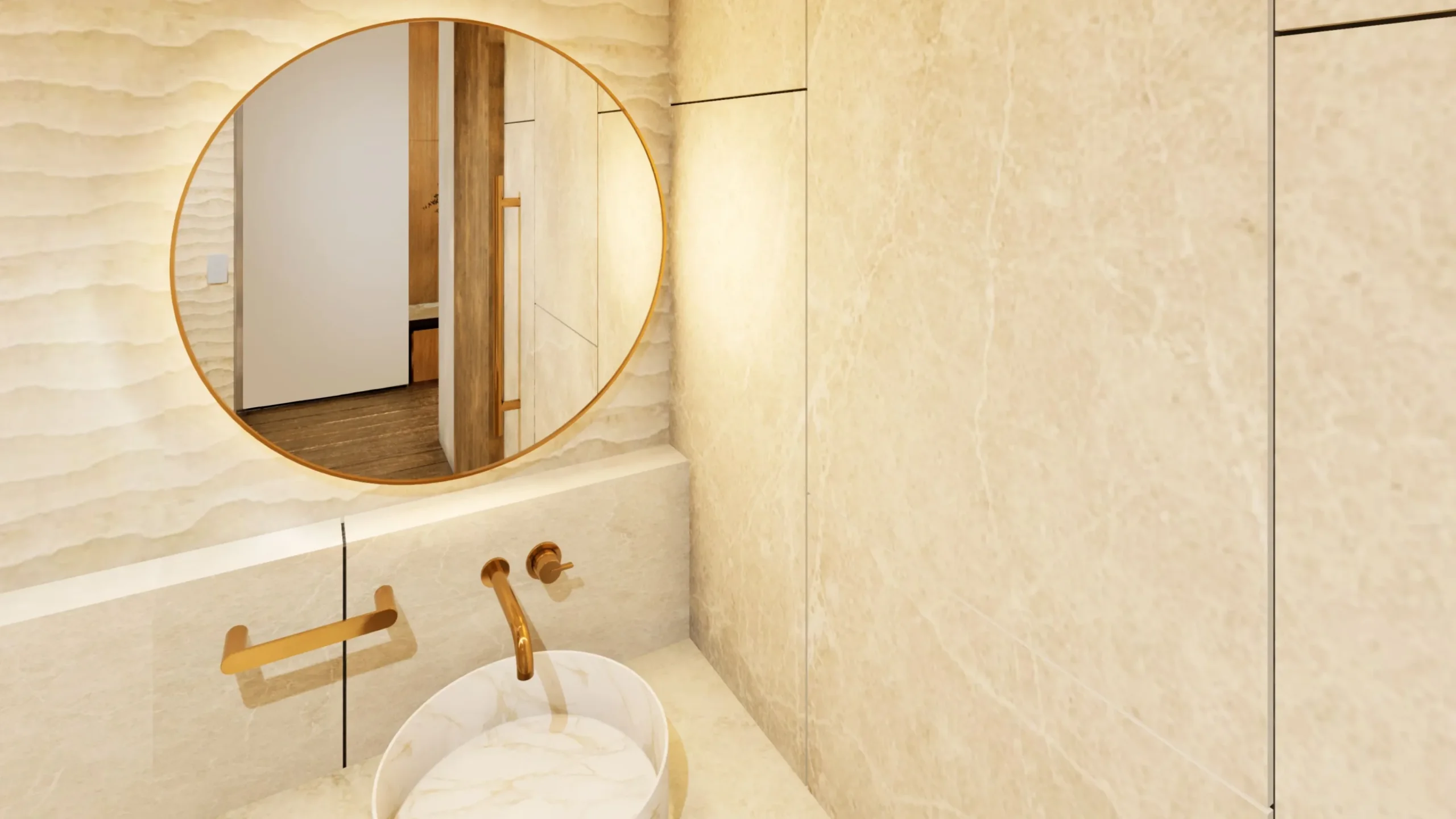
The cost story: Stone and engineered-stone tops run at roughly A$700 to A$2,000 per linear metre installed, well above a standard laminate or ceramic top, and a cast concrete basin sits above a mass-produced ceramic one. The variation that makes concrete beautiful also means it should be seen in context, because no two pieces are identical.
The smart toilet, and the power point nobody budgets for
A smart toilet suite brings bidet washing, seat heating and often automatic lid operation into the room. It is a genuine comfort upgrade, and it is also a common source of budget surprise, because a smart toilet is an electrical appliance as much as a sanitary fixture.
The cost story: Beyond the unit itself, installation typically runs around A$500 to A$1,200, and the pan needs a grounded power outlet within roughly a metre. If one is not already there, adding it costs about A$200 to A$400, and it must be planned with the electrician before the wall is closed and tiled.
In-wall heating and a controller, instead of a radiator on the wall
Rather than a visible heater, the specification uses an in-wall panel with a dedicated touch controller. The panel disappears into the wall build-up and warms the room quietly, which preserves the calm, uncluttered surfaces the design depends on.
The cost story: This is a design-stage decision, not a fit-out one. The wall depth, the electrical circuit and the controller position all have to be resolved before lining. Chosen late, it either cannot be done or forces rework.
Under-tile heating, the comfort you only notice barefoot
Under-tile heating sits beneath the floor finish and takes the chill out of tile in a coastal Melbourne winter. It is the single upgrade most owners of a heated bathroom say they would never give up, and it is invisible.
The cost story: It must be installed before the tiles, which makes it a strictly pre-tiling decision. Retrofitting later means lifting the floor, so the true cost of deciding late is the entire floor finish, not the heating.
The grate and the channel: Drainage as a design decision
Two small items do a lot of work here: A brushed gold linear floor grate and a slimline brass channel drain. A tile-insert or linear grate replaces the traditional centre floor waste and its four-way fall, which is what allows a large-format tile to run cleanly across the floor and into the shower without visual interruption.
The cost story: These items cost more than a standard round waste, but the real cost is in the floor. Linear drainage changes the falls, the waterproofing detail and the tile setout, so it must be designed in from the start. Chosen well, it is what makes a level-access, single-plane wet room possible.
The mirror that changes the colour of everything
The specification includes an LED mirror with adjustable colour temperature. This is a functional choice as much as a decorative one: A warm light flatters the room at night, while a cooler, daylight-balanced light is what you actually want for grooming, and CCT switching gives you both from one fitting.
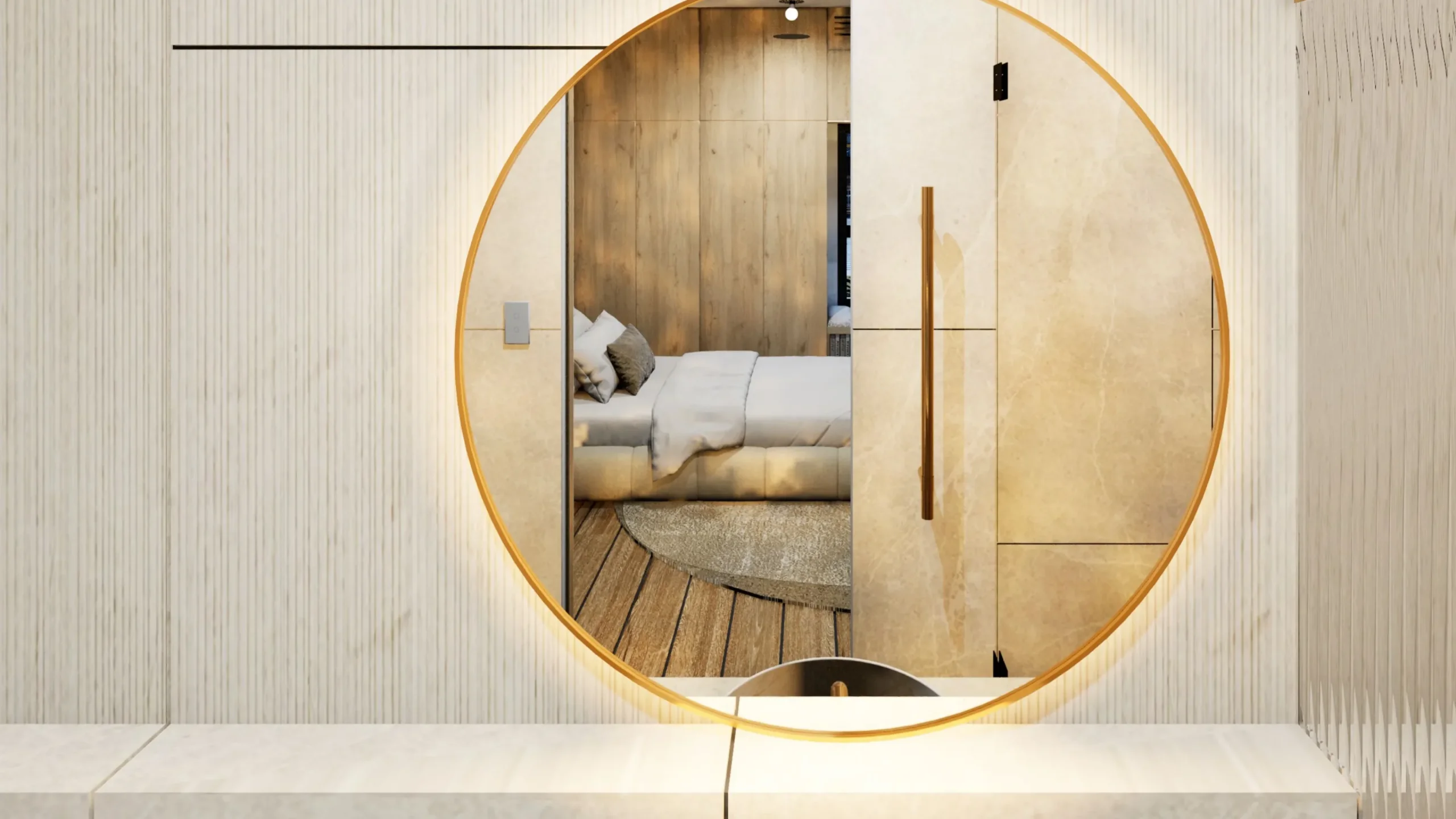
The cost story: An LED CCT mirror costs more than plain glass and needs a power supply coordinated behind it. It is also the element that most changes how every other finish in the room reads, because your brass, stone and tile will look different under 2700K than under 5000K. That is precisely why finishes should be reviewed under realistic lighting before they are ordered.
What this specification teaches about budgeting a bathroom
Read together, the Project 251 bathroom makes the same point in six different ways: The expensive decisions in a luxury bathroom are the ones taken before anything is installed. The in-wall mixer, the in-wall heater, the under-tile heating and the linear drainage are all invisible in the finished room, and all four are effectively impossible to add cheaply once the walls are lined and the floor is tiled. The visible items, the tapware finish, the basin, the mirror, are the ones people budget for, and they are the ones that can still be changed late.
That is why reviewing a bathroom in context, at full scale and under realistic light, is not a presentation exercise. It is how you confirm the finish language, the vanity and basin pairing, the mirror light and the drainage strategy while every one of those choices is still free to change.
Learn more: architectural visualisation Melbourne for project decisions
How to keep your bathroom remodel on budget
- Lock the layout early: Decide whether plumbing moves before anything else, because it sets the budget band.
- Confirm finishes before demolition: Resolve tapware, tiles, vanity and heating while changes are still free.
- Hold a contingency: Keep 10 to 15% aside for hidden conditions found after strip-out.
- Get itemised quotes: Compare like-for-like scope, not headline prices, and check what is excluded.
- Do not compromise waterproofing: It is mandatory, and the most expensive thing to fix.
- Use licensed trades: Plumbing, waterproofing and electrical work must be done by licensed tradespeople.
Who delivered 251 Station St., and what each party was responsible for
A project this coordinated only works when every role is defined before work starts on site. The 251 Station St. team was structured so that design intent, buildability and compliance were resolved inside one shared model, rather than being reconciled through variations once the frame was up. The credits below name each party and the scope they carried.
Project Superintendent and Project Control: Feel DX
Feel DX held the superintendent and project control function, which means owning the programme, the decision register and the cost and time consequences of every change. This is the discipline that keeps a build predictable: A decision resolved before tender costs nothing, while the same decision made mid-construction is priced at the builder’s margin with no competitive leverage left.
Principal Building Contractor: Willoworks
Willoworks, a Bayside Melbourne residential and commercial builder and Master Builders member, held the construction contract and site responsibility, delivering the built work against the coordinated documentation.
Architect and co-design: Plico Design Studio with Feel DX
Plico Design Studio, a Port Melbourne practice known for architecture, interiors and heritage research, led the architectural design. Feel DX worked alongside them in a co-design capacity, testing spatial options and material decisions in the model so the client could review each choice at full scale before it was documented.
4D design and visualisation: Feel DX and DX Living
This is the core of the platform: A BIM-integrated model sequenced against the construction programme, so form, finish and staging can be interrogated together. Immersive review closes the gap between a drawing and lived spatial reality, which is where most late-stage change orders originate.
Interior and exterior design: Feel DX
Interior and exterior schemes were developed inside the same model rather than as a separate parallel workstream, keeping finishes, joinery and facade decisions aligned with the documented base build.
Building Surveyor: C & M Building Surveyors
Building permits, inspections and occupancy certification were handled by a registered private building surveyor, confirming compliance with the National Construction Code at each statutory hold point.
Key insight: The value in this structure is not that any one party did more. It is that design authorship, project control and visualisation shared a single source of truth, so decisions were made once, early, and in a form the client could actually see.
Conclusion
A realistic bathroom remodel cost in Australia in 2026 runs from around A$10,000 for a basic refresh to A$25,000 or more for a full luxury renovation, with the layout, plumbing, tiling extent and fixtures tier moving the number most. The figures here are indicative market ranges; a licensed trade should quote your specific room. The most controllable cost is the one most people overlook: The variation. Confirm your layout and finishes before the work begins, and the budget you agree is far more likely to be the budget you pay.
Want to see your new bathroom before you spend on it? Contact DX Living to visualise your finishes and layout before you commit.
FAQs
Q: What is the average bathroom remodel cost in Australia in 2026?
A: A full bathroom remodel generally falls between about A$10,000 and A$35,000+, with the Housing Industry Association putting the average mid-range project at roughly A$26,000, or around A$2,300 to A$4,600 per m². Treat these as indicative until a licensed trade quotes your room.
Q: What is the biggest factor in a bathroom remodel cost?
A: Whether the plumbing moves. Keeping the toilet, shower and basin in place holds a project in the basic-to-standard range, while relocating them, and the tiling and waterproofing that follow, pushes it into luxury-renovation territory.
Q: How is a bathroom renovation budget usually divided?
A: Labour is typically 40 to 60% of the total. Plumbing is around 20 to 25%, tiling 25 to 35%, waterproofing a smaller but mandatory line of roughly A$800 to A$2,500, and fixtures and fittings from A$2,000 to A$15,000+.
Q: Why are bathrooms so expensive to renovate?
A: Multiple trades, mandatory waterproofing to AS 3740, and labour-intensive tiling all meet in a small space, so cost per square metre is high even before premium finishes.
Q: How can I reduce my bathroom remodel cost without cutting corners?
A: Keep the existing layout, spend on waterproofing and labour rather than the most expensive tile, hold a contingency for hidden conditions, and confirm every finish before demolition so you avoid mid-project variations.
Q: Does location change the cost?
A: Yes. Sydney homeowners typically pay around 15 to 25% above the national average, and other capital cities vary with local labour rates and compliance requirements.
References
- Housing Industry Association (HIA). Renovations and home improvement data.
- Australian Building Codes Board. National Construction Code (NCC).
- Standards Australia. AS 3740 Waterproofing of domestic wet areas.
- Three Birds Renovations. How much does a bathroom renovation cost in 2026?
- Co-Architecture. Bathroom renovation cost Australia 2026.
- myHomeware. Bathroom renovation cost Australia: budget guide 2026.
Related Articles
The pre-contract checklist: 18 things to confirm before you sign with a builder
Before you sign with a builder checklist: The 18 things to confirm on the contract, the specification and the plan, and what each one costs if you miss it.
Read MorePlanning a home cinema in Australia: What drives the cost and how to review it in VR first
Home cinema cost Australia: Indicative 2026 budgets across four tiers, the seven items that actually drive the number, and how to review the room in VR.
Read MoreLiving room trends in Australia for 2026 and 2027: How to test them in 3D before you commit
Living room trends Australia: The 10 directions shaping 2026 and 2027, which ones survive a decade, and how to test each in 3D before you commit.
Read More